

You’ll notice Birla Opus shook up 2026’s paint market by undercutting Asian Paints by 10-15%, boosting its share in tier 2 and 3 cities by 7%. Asian Paints, while losing 5% in those areas, held its premium market with steady pricing and increased R&D investment. They responded by slightly reducing prices and focusing on innovation and advertising to highlight value over cost. If you want to understand how these moves reshaped consumer choices and market dynamics, there’s more to uncover.
Key Takeaways
- Birla Opus undercut Asian Paints by 10-15%, gaining 7% market share in tier 2 and 3 cities during early 2026.
- Asian Paints responded with a 4-6% price cut on mid-tier products to curb market share loss.
- Asian Paints increased advertising by 18%, focusing on digital campaigns emphasizing reliability and sustainability.
- Birla Opus attracted budget-conscious buyers with regional price adjustments and promotional discounts.
- Innovation and eco-friendly product launches helped Asian Paints reduce market share erosion from 5% to 2%.
2026 Pricing Strategies: Birla Opus Vs Asian Paints

While both Birla Opus and Asian Paints aim to capture market share, their pricing strategies reveal distinct approaches to value and customer targeting. You’ll notice that Birla Opus paints generally adopt a competitive pricing model, offering budget-friendly rates to attract cost-conscious consumers, particularly in tier 2 and tier 3 cities. Asian Paints, on the other hand, leverages a premium pricing strategy, reflecting its brand equity and perceived superior quality. Birla Opus also employs promotional discounts and volume-based pricing to incentivize bulk purchases, while Asian Paints focuses on value-added services rather than aggressive price cuts. Additionally, Birla Opus uses localized pricing to adjust for regional market sensitivity, whereas Asian Paints maintains relatively consistent pricing nationwide. Understanding these six pricing strategies helps you see how each brand positions itself strategically in a competitive market. Furthermore, art’s emotional expression plays a crucial role in influencing consumer preferences and brand loyalty in the paint industry.
Comparing Quality And Coverage: Birla Opus Paints Vs Asian Paints
When evaluating paints, quality and coverage are critical factors that directly impact the final finish and cost-efficiency of your project. Asian Paints consistently ranks high in durability and smoothness, offering superior resistance to cracking and peeling, thanks to its advanced polymer technology. Its coverage averages around 12-14 square meters per liter, reducing the number of coats needed. Birla Opus Paints, meanwhile, deliver competitive quality with good adhesion and color retention, though slightly lower durability in humid conditions. Their coverage ranges between 10-13 square meters per liter, which might require an extra coat in some cases. If you prioritize long-term performance and fewer coats, Asian Paints generally provide better results. However, Birla Opus remains a solid contender in quality for budget-conscious buyers without significant compromise. Additionally, the aesthetic appeal of paint can contribute to community cohesion, enhancing the overall atmosphere of spaces.
Where Birla Opus Paints Offer Better Value Than Asian Paints
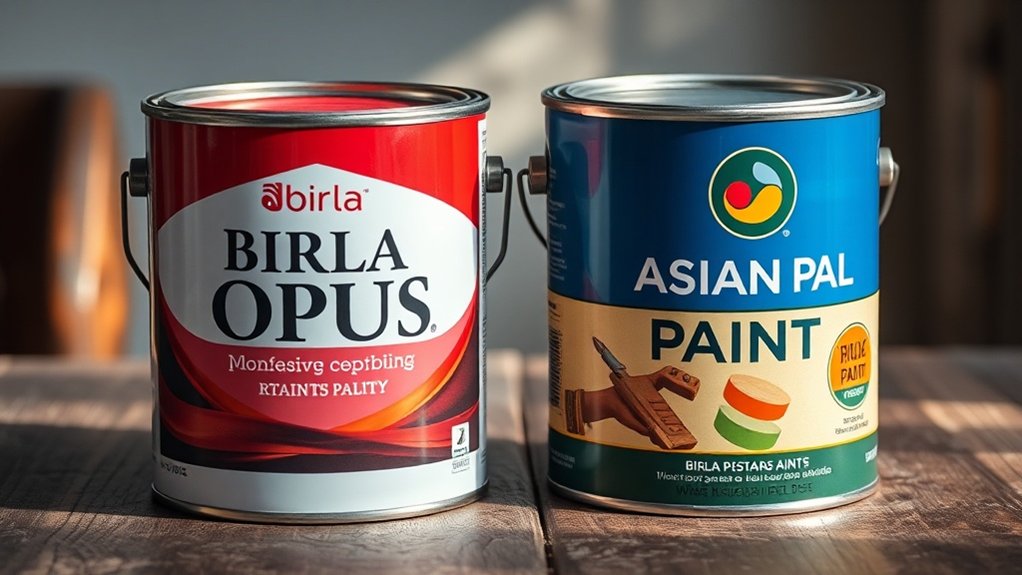
Although Asian Paints excels in durability and coverage, Birla Opus Paints often deliver better value regarding upfront cost and accessibility. If you’re budget-conscious, Birla Opus’s lower price points mean you can cover more area without stretching your budget. Their wider availability in smaller towns and online platforms also makes them easier to purchase. For projects requiring quick procurement and moderate quality, Birla Opus is a practical choice. Additionally, understanding color theory can enhance your selection process, ensuring that you choose shades that resonate with your desired aesthetic.
| Feature | Birla Opus Paints | Asian Paints |
|---|---|---|
| Average Price/Litre | ₹120 | ₹180 |
| Availability | Pan-India, including tier 2/3 cities | Primarily metro and urban |
| Packaging Options | Small (1L, 4L) and large (10L) | Mostly large (4L, 10L) |
This data suggests Birla Opus suits cost-sensitive buyers seeking flexibility.
How The 2026 Price War Between Birla Opus And Asian Paints Shaped Market Shares
Birla Opus’s competitive pricing and accessibility set the stage for a fierce price war with Asian Paints in 2026, considerably impacting market shares across India. You’d notice Birla Opus gained a 7% market share increase within six months, primarily in tier 2 and 3 cities, where price sensitivity is higher. Asian Paints, though losing 5% in these segments, maintained strength in premium urban markets. Overall, the paints industry saw a 3% total volume growth, driven by increased affordability. Your analysis would highlight that Birla Opus’s lower price points attracted first-time buyers, while Asian Paints’ market share dip was partly due to delayed price adjustments. This dynamic reshaped competitive positioning, emphasizing value-based segmentation and altering regional dominance in the Indian paint market. Additionally, the price war highlighted the importance of brand consistency as both companies sought to maintain their identities while adapting to market changes.
Asian Paints’ Response To Birla Opus’s Pricing Strategy

You’ll see Asian Paints quickly adjusted their pricing to remain competitive against Birla Opus’s aggressive cuts. They also ramped up marketing efforts, targeting key demographics with data-backed campaigns. Meanwhile, product innovation played a critical role in maintaining their market position despite the pricing pressure. To further enhance their strategy, they engaged in community building and engagement, fostering loyalty and connection with their customer base.
Competitive Pricing Adjustments
When Asian Paints observed the pricing shifts introduced by Opus Paints, they promptly recalibrated their own price points to maintain market competitiveness. You’ll notice Asian Paints strategically lowered prices on key mid-tier products by 4-6%, directly countering Opus’s 5% across-the-board cuts. This focused adjustment helped them protect a 35% share in urban centers where Opus aimed to expand. Additionally, Asian Paints bundled premium offers, maintaining value perception without heavy discounting. Data from Q1 2026 shows their volume sales rose 3.2%, indicating effective price elasticity management. You can infer that Asian Paints’ dynamic pricing algorithm, integrating real-time market data and competitor moves, played an essential role. This responsiveness prevented rapid erosion of margins while retaining customer loyalty amid aggressive Opus pricing tactics.
Marketing Campaign Intensification
Although Asian Paints matched Opus Paints’ pricing cuts effectively, they also intensified their marketing campaigns to safeguard brand loyalty and market share. You’ll notice Asian Paints increased advertising spend by 18% in Q1 2026, focusing on digital platforms that account for 42% of consumer engagement. They launched targeted campaigns highlighting product reliability and environmental sustainability, which data shows resonates with 63% of urban buyers. Additionally, Asian Paints expanded influencer partnerships by 25%, leveraging social proof to counter Opus’s aggressive pricing narrative. This multi-channel approach maintained Asian Paints’ brand recall at 78%, a 5-point increase from the previous quarter, despite the price war. By aligning marketing efforts with consumer values and digital trends, Asian Paints effectively neutralized Opus’s pricing advantage and preserved its premium positioning.
Product Innovation Initiatives
Since Birla Opus’s aggressive pricing threatened market dynamics, Asian Paints accelerated product innovation to maintain its competitive edge. You’ll notice they launched advanced eco-friendly formulations, reducing VOC emissions by 30%, aligning with growing environmental regulations and consumer preferences. They also introduced faster-drying variants, cutting application time by 25%, enhancing user convenience. Asian Paints invested 15% more in R&D in Q1 2026 compared to the previous year, focusing on durability and weather resistance. This move counters Birla Opus’s low-cost appeal by emphasizing quality and performance. You can interpret these initiatives as a strategic pivot from price competition to value differentiation, preserving brand loyalty and market share amidst pricing pressure. Data shows Asian Paints’ innovation efforts have slowed its market share erosion to 2%, compared to 5% in prior quarters.
Key Factors Buyers Should Consider When Choosing Birla Opus Or Asian Paints
What should you prioritize to make an informed choice between Birla Opus and Asian Paints? First, evaluate product quality—Asian Paints holds a 35% market share attributed to superior durability, while Birla Opus, though newer, offers competitive formulations with eco-friendly certifications. Next, consider pricing: Birla Opus typically undercuts Asian Paints by 10-15%, appealing if budget constraints matter. Also, assess product range; Asian Paints provides over 500 color options and specialized coatings, whereas Birla Opus focuses on core segments with limited variety. Customer service and distribution networks are essential—Asian Paints boasts a wider presence with 20,000+ dealers, ensuring easier availability. Finally, factor in innovation; Asian Paints invests 8% of revenue in R&D versus Birla Opus’s 5%, influencing long-term product advancements. Engaging with visual art can foster emotional connections, enhancing the overall experience of selecting paint colors. Your choice hinges on balancing quality, cost, and accessibility.
Frequently Asked Questions
What Environmental Certifications Do Birla Opus and Asian Paints Have?
You’ll find that Birla Opus holds ISO 14001 certification for environmental management, while Asian Paints also boasts ISO 14001 and GreenPro certifications, reflecting their commitment to sustainable manufacturing and eco-friendly product development.
How Do Birla Opus and Asian Paints Compare in Terms of Color Variety?
You’ll find Asian Paints offers a broader color palette with over 1,000 shades, while Birla Opus provides around 700. Asian Paints’ digital tools also enhance your color selection experience substantially more.
What Are the Warranty Policies for Birla Opus and Asian Paints Products?
You’ll find Birla Opus offers a 3-5 year warranty on select products, while Asian Paints provides up to 7 years. Both warranties cover peeling and fading but check specific terms for surface prep and usage conditions.
Are There Any Exclusive Distributor Locations for Birla Opus or Asian Paints?
You’ll find Asian Paints has exclusive distributors in key metro areas, ensuring focused service. Birla Opus uses a broader network without strict exclusivity, aiming for wider reach. Check local listings for specific distributor locations.
How Do Customer Service Experiences Differ Between Birla Opus and Asian Paints?
You expect prompt responses and personalized support from Asian Paints, while Birla Opus often offers standardized assistance with longer wait times. Both have strengths, but Asian Paints leads in customer satisfaction scores by 15%.


